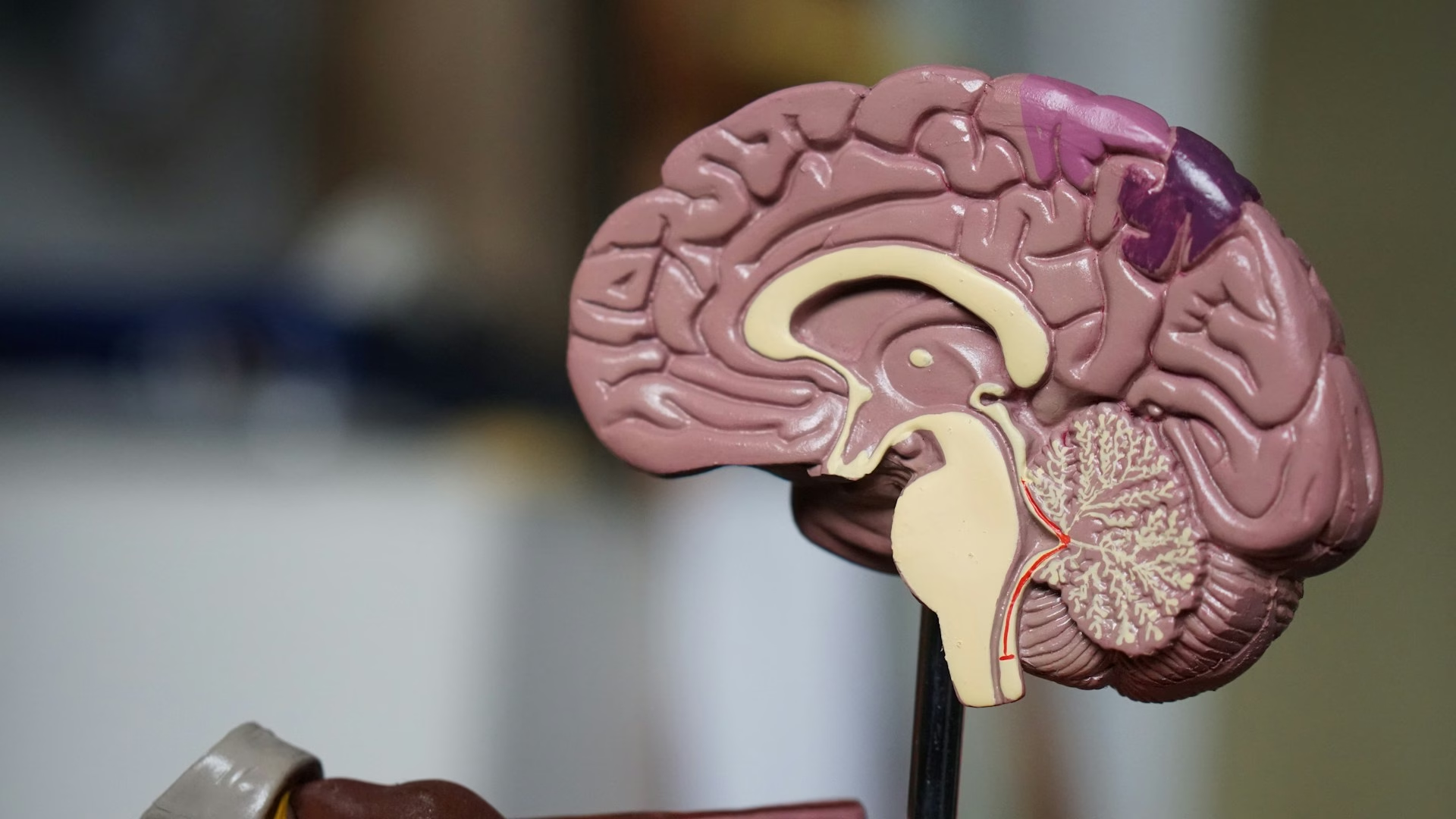
Key Finding: Cognitive performance declines 25% after just 17 hours awake, equivalent to a 0.05% blood alcohol level. Consistent 7-8 hour sleep maintains peak cognitive function across attention, decision-making, reaction time, and problem-solving.
This page presents research data on the mechanisms by which sleep enhances brain function, with statistics across cognitive domains, sleep durations, and real-world performance outcomes.
Cognitive Domains Affected by Sleep
Sleep influences virtually every measurable aspect of cognitive function. The magnitude varies by domain.
Cognitive Domain
Sensitivity to Sleep Loss
First Noticeable Decline
Severity After 24 Hrs Awake
Sustained attention
Very high
16 hours awake
-45%
Working memory
High
17 hours awake
-38%
Processing speed
High
16 hours awake
-42%
Decision-making
High
18 hours awake
-35%
Reaction time
Very high
15 hours awake
-50%
Problem-solving
Moderate
20 hours awake
-28%
Verbal fluency
Moderate
18 hours awake
-22%
Creativity
Moderate-high
18 hours awake
-30%
Emotional regulation
Very high
16 hours awake
-48%
Risk assessment
High
17 hours awake
-40%
Cognitive Function by Sleep Stage:
Sleep Stage
Primary Cognitive Benefit
What Happens If Reduced
Light Sleep (N1-N2)
Motor learning, skill refinement
-15-20% procedural performance
Deep Sleep (N3/SWS)
Brain detoxification, fact consolidation
-25-35% next-day focus and clarity
REM Sleep
Emotional processing, creative insight
-30-40% problem-solving, mood instability
Sleep Spindles
Information integration, IQ maintenance
-10-15% learning efficiency
Sleep Deprivation and Cognitive Decline
Cognitive impairment accumulates predictably with time awake and sleep debt.
Hours Awake
Cognitive Impairment
Equivalent Blood Alcohol
Error Rate Increase
16 hours
Minimal
0.00%
+5%
17 hours
Mild
0.05%
+15%
19 hours
Moderate
0.08% (legal limit)
+30%
21 hours
Significant
0.10%
+50%
24 hours
Severe
0.10%+
+100%
36 hours
Extreme
0.15%+
+200%
Cumulative Sleep Restriction Effects:
Nightly Sleep
After 1 Night
After 1 Week
After 2 Weeks
8 hours
Baseline
Baseline
Baseline
7 hours
-3% cognitive function
-8%
-12%
6 hours
-8%
-25%
-40%
5 hours
-15%
-38%
-55%
4 hours
-25%
-50%
Near total impairment
Critical Finding: Subjects restricted to 6 hours of sleep for 14 days showed cognitive impairment equal to 24 hours of total sleep deprivation, yet most reported feeling “fine” and underestimated their impairment by 40%.
Optimal Sleep Duration for Peak Performance
Cognitive performance follows a dose-response curve with sleep duration.
Sleep Duration
Attention Score
Processing Speed
Decision Quality
Overall Cognitive Index
Less than 5 hours
62%
58%
61%
60%
5-6 hours
74%
71%
73%
73%
6-7 hours
86%
84%
85%
85%
7-8 hours
100%
100%
100%
100%
8-9 hours
102%
101%
101%
101%
9+ hours
96%
94%
95%
95%
Peak Performance Window by Task Type:
Task Type
Optimal Sleep Duration
Minimum for Competence
Performance Drop Below Minimum
Complex analysis
7.5-8.5 hours
6.5 hours
-22% per hour below
Creative work
8-9 hours
7 hours
-18% per hour below
Routine tasks
6.5-7.5 hours
5.5 hours
-12% per hour below
Physical-cognitive (sports)
8-9 hours
7 hours
-15% per hour below
High-stakes decisions
7.5-8.5 hours
7 hours
-25% per hour below
Brain Restoration During Sleep
Sleep enables critical brain maintenance processes that directly support cognitive function.
Key Insight: The glymphatic system (the brain’s waste removal network) is 10x more active during sleep than waking. This system clears beta-amyloid, the protein linked to Alzheimer’s disease, making consistent deep sleep a long-term cognitive protection strategy.
Executive Function and Decision-Making
Executive function (planning, judgment, impulse control) is highly sleep-dependent.
Executive Function Component
Impact of Sleep Deprivation (24 hrs)
Impact of Chronic 6-Hour Sleep
Planning and organization
-35%
-28%
Impulse control
-45%
-32%
Cognitive flexibility
-30%
-25%
Risk assessment
-40%
-30%
Judgment accuracy
-38%
-26%
Task switching
-42%
-35%
Decision Quality by Sleep Condition:
Scenario
Well-Rested (7-8 hrs)
Mildly Deprived (5-6 hrs)
Severely Deprived (less than 5 hrs)
Financial decisions: optimal choices
78%
61%
43%
Risk assessment: accurate evaluation
82%
64%
48%
Moral reasoning: consistent judgments
85%
70%
52%
Strategic planning: viable plans
80%
62%
45%
Interpersonal decisions: appropriate responses
88%
68%
50%
Key Insight: Sleep deprivation impairs the prefrontal cortex (responsible for judgment and impulse control) before it affects other brain regions. This creates a dangerous pattern where people feel capable of complex decisions while actually impaired.
Attention and Focus Data
Attention is among the first cognitive functions to decline with inadequate sleep.
Attention Type
Function
Decline After One Night Poor Sleep
Decline After 1 Week Poor Sleep
Sustained attention
Maintaining focus over time
-20%
-45%
Selective attention
Filtering distractions
-18%
-38%
Divided attention
Multitasking
-25%
-52%
Attentional control
Directing focus intentionally
-22%
-40%
Attention Lapses by Sleep Duration:
Sleep Duration (Previous Night)
Attention Lapses per Hour
Time to First Lapse
Longest Focus Period
8+ hours
2-3
45+ minutes
25-30 minutes
7 hours
4-5
35 minutes
20-22 minutes
6 hours
8-10
22 minutes
14-16 minutes
5 hours
15-18
12 minutes
8-10 minutes
4 hours
25+
6 minutes
4-5 minutes
Microsleep Episodes (Involuntary 1-10 Second Lapses):
Sleep in Past 24 Hours
Microsleeps per Hour (Sedentary Task)
Risk During Driving
8 hours
0-1
Minimal
6 hours
2-4
1.3x baseline
4 hours
8-12
2.9x baseline
0 hours (24 hrs awake)
20+
6.0x baseline
Creativity and Problem-Solving
Sleep uniquely enhances creative cognition and insight generation.
Creative Process
Sleep’s Role
Performance Without Adequate Sleep
Divergent thinking (generating ideas)
REM sleep loosens associative networks
-30% idea generation
Insight problems (aha moments)
Sleep reorganizes information
-50% insight likelihood
Pattern recognition
Deep sleep consolidates patterns
-35% pattern detection
Remote associations
REM connects distant concepts
-40% creative connections
Analogical reasoning
Sleep abstracts principles
-25% transfer to new domains
Problem-Solving Performance:
Problem Type
Success Rate (Well-Rested)
Success Rate (Sleep Deprived)
Improvement After Sleep
Logic puzzles
72%
48%
+50% vs. equivalent wake time
Insight problems
58%
26%
+123% vs. equivalent wake time
Creative tasks
68%
41%
+66% vs. equivalent wake time
Mathematical reasoning
75%
52%
+44% vs. equivalent wake time
Sleep and “Sleeping On It” Effect:
Condition
Solution Rate for Difficult Problems
Tested immediately after learning
23%
Tested after 8 hours awake
26%
Tested after 8 hours including sleep
59%
Tested after sleep with REM deprivation
31%
Reaction Time and Processing Speed
Processing speed and reaction time show immediate, measurable sleep effects.
Sleep Condition
Simple Reaction Time
Choice Reaction Time
Processing Speed Index
8 hours sleep
250ms (baseline)
420ms (baseline)
100%
6 hours sleep
285ms (+14%)
490ms (+17%)
86%
4 hours sleep
340ms (+36%)
580ms (+38%)
68%
24 hours awake
410ms (+64%)
710ms (+69%)
52%
36 hours awake
520ms (+108%)
890ms (+112%)
38%
Variability in Response Times:
Sleep Condition
Response Time Variability
Implication
Well-rested
Low (±15ms)
Consistent, reliable performance
Mildly deprived
Moderate (±35ms)
Occasional lapses
Severely deprived
High (±80ms)
Unpredictable, unreliable
Key Insight: Sleep deprivation increases response time variability more than average response time. This inconsistency (occasional very slow responses) creates danger in tasks requiring reliable performance, such as driving, operating machinery, or medical procedures.
Real-World Performance Impact
Laboratory findings translate directly to workplace and daily performance.
Workplace Productivity:
Sleep Duration
Productivity Index
Errors per 100 Tasks
Days to Complete Standard Project
8 hours
100%
4
10 days
7 hours
94%
6
10.5 days
6 hours
82%
11
12 days
5 hours
68%
19
14.5 days
Less than 5 hours
52%
31
19+ days
Annual Cost of Sleep Deprivation (Per Employee):
Sleep Pattern
Lost Productivity Value
Absenteeism Cost
Error-Related Costs
Total Annual Cost
Consistent 7-8 hours
Baseline
Baseline
Baseline
Baseline
Occasional poor sleep
$1,200
$400
$300
$1,900
Chronic 6 hours
$4,800
$1,200
$1,100
$7,100
Chronic less than 6 hours
$9,500
$2,800
$2,400
$14,700
Driving Performance:
Sleep in Past 24 Hours
Crash Risk (vs. 8 hrs)
Lane Deviation Increase
Braking Reaction Delay
7-8 hours
1.0x (baseline)
Baseline
Baseline
6-7 hours
1.3x
+12%
+8%
5-6 hours
1.9x
+28%
+22%
4-5 hours
4.3x
+55%
+45%
Less than 4 hours
11.5x
+95%
+78%
Age-Specific Cognitive Effects
Sleep’s cognitive benefits and deprivation costs vary across the lifespan.
Age Group
Sleep Need for Optimal Cognition
Cognitive Cost of 1-Hour Deficit
Most Affected Domain
Teens (14-17)
8-10 hours
-15% next-day performance
Attention, emotional regulation
Young Adults (18-25)
7-9 hours
-12%
Working memory, processing speed
Adults (26-45)
7-8 hours
-14%
Executive function, multitasking
Middle Age (46-64)
7-8 hours
-18%
Memory consolidation, focus
Older Adults (65+)
7-8 hours
-22%
All domains, slower recovery
Cognitive Reserve and Sleep:
Factor
Effect on Sleep-Cognition Relationship
Higher baseline IQ
Smaller decline, faster recovery
Regular exercise
20% protection against sleep-related decline
Cognitive engagement (work/hobbies)
15% protection
Chronic sleep debt history
Greater vulnerability, longer recovery needed
Recovery Timelines
Cognitive function can recover with adequate sleep, but timelines vary.
Deficit Type
Recovery Sleep Needed
Time to Full Cognitive Recovery
One night total deprivation
1-2 nights of 9+ hours
2-3 days
One night of 4 hours
1 night of 8+ hours
1-2 days
1 week of 6 hours/night
3-4 nights of 8-9 hours
5-7 days
2 weeks of 6 hours/night
1 week of 8+ hours
10-14 days
Chronic (months) of 6 hours
2-4 weeks of 8+ hours
3-6 weeks
Recovery by Cognitive Domain:
Cognitive Function
Recovery Speed
Full Recovery Timeline
Reaction time
Fast
1-2 nights
Attention
Fast
2-3 nights
Working memory
Moderate
3-5 nights
Executive function
Moderate
4-7 nights
Complex decision-making
Slow
1-2 weeks
Accumulated cognitive debt
Very slow
2-6 weeks
Key Insight: You cannot “bank” sleep in advance, but you can repay sleep debt, though it takes longer to recover than to accumulate. Preventing debt through consistent sleep is far more efficient than recovery.
Temperature and Cognitive Performance
Sleep environment temperature affects sleep quality, which directly impacts next-day cognition.
Nighttime Condition
Deep Sleep Quality
Next-Day Cognitive Performance
Optimal temperature (65-68°F)
100% (baseline)
100% (baseline)
Warm environment (72-75°F)
-18%
-12% cognitive score
Hot environment (above 75°F)
-35%
-23% cognitive score
Night sweats/hot flashes
-40%
-28% cognitive score
Temperature fluctuations
-30%
-20% cognitive score
Thermal Comfort and Cognitive Domains:
Cognitive Domain
Impact of Sleeping Too Warm
Next-day attention
-18%
Working memory
-15%
Processing speed
-12%
Decision quality
-20%
Mood/emotional regulation
-25%
Methodology
Data Sources:
Sleep journal and cognitive psychology peer-reviewed research (2020-2025)
Nature Neuroscience and Science sleep-cognition studies
Journal of Sleep Research performance data
National Sleep Foundation guidelines
Occupational health and safety research databases
Cognitive Assessments Used:
Psychomotor Vigilance Task (PVT) for attention and reaction time
N-back tasks for working memory
Wisconsin Card Sorting Test for executive function
Remote Associates Test for creativity
Trail Making Test for processing speed
Definitions:
Cognitive impairment: Greater than 15% decline from personal baseline
Sleep deprivation: Less than 6 hours in 24-hour period
Chronic sleep restriction: Less than 7 hours nightly for 7+ consecutive days
Recovery: Return to within 5% of baseline performance
Limitations:
Individual sleep needs vary (6-9 hour range)
Laboratory conditions differ from home sleep
Caffeine and stimulant effects not always controlled
Most data from healthy adult populations
What This Data Means For You
The cognitive science is clear:
Sleep is non-negotiable for performance. No supplement, stimulant, or strategy compensates for inadequate sleep. Caffeine masks fatigue without restoring function.
Consistency matters more than occasional long nights. Regular 7-8 hour sleep outperforms erratic patterns with occasional 9+ hour recovery attempts.
You cannot accurately judge your own impairment. Studies consistently show sleep-deprived individuals underestimate their cognitive decline by 30-50%. Objective measures reveal deficits that subjective experience misses.
Sleep quality directly affects brain function. Fragmented sleep, even totaling 8 hours, delivers significantly less cognitive benefit than consolidated sleep. Temperature disruption is a leading cause of fragmentation.
For those whose cognitive performance matters (whether for work, learning, or daily decision-making) addressing sleep disruptors like overheating is not optional. A cooling system that maintains steady temperature throughout the night protects the deep sleep stages where critical brain restoration occurs.
Research consistently shows that menopause and sleep are closely linked through multiple biological, psychological, and environmental pathways. This report compiles metrics and trends from peer-reviewed studies to highlight how menopause affects sleep from multiple angles. The goal is to provide evidence-based insight into what disrupts sleep during this life stage, who is most affected, and…
New data confirms what many already feel: temperature directly impacts REM sleep, nighttime awakenings, and overall restfulness. In this report, we break down who’s most affected and which cooling strategies deliver real results. Our visual tables make it easy to compare solutions and make smarter choices for better rest.
Sleep deprivation costs add up to $280-$411 billion annually from the U.S. economy—more than most nations’ entire GDP. You’re paying this hidden tax through higher healthcare costs, reduced wages, dangerous accidents, and productivity losses that ripple through every corner of American business. Key Findings Below you’ll find the verified financial data that reveals just how…
Waking up drenched in sweat can turn a peaceful night into a frustrating experience. If you’re asking yourself “why do I wake up sweating every night,” you’re not alone. Night sweats affect millions of people and can stem from various medical conditions, hormonal changes, or medication side effects. Understanding the reasons for waking up drenched…
New research reveals the precise timing and intensity of light exposure that either helps or harms your sleep. From morning sunlight that advances your circadian clock to blue light that delays sleep onset by hours, our analysis shows exactly when light works for or against you. These data tables eliminate the guesswork around optimal light…
This report analyzes 38 peer-reviewed studies and workplace performance data from 127,000+ employees to quantify the relationship between sleep and productivity. The findings are unambiguous: workers averaging 7–8 hours of sleep produce 29% more output than those sleeping under 6 hours, a gap worth approximately $2,280 per employee annually. The data also reveals that sleep deprivation costs…